
Our Tele-3D Differentiators

Clinical Expertise for Tertiary-Care Complexity
Complex anatomy demands more than automated reconstruction. Our experts interpret the anatomy, recognize artifacts and anatomical variations, and determine which views and techniques best represent the clinical question, creating 3D visualizations that support complex clinical decision-making.
Expertise Built Around an MGH Standard
Our Tele-3D service follows a standardized protocol developed by MGH. It provides a consistent standard for every reconstruction, regardless of the technologist or site handling the study. Every study follows the same protocol, regardless of the technologist or site handling it.

Subspecialty-Specific Reconstructions
Our teams work across six clinical areas — neuro, cardiovascular, chest, abdominal, MSK and breast. Each subspecialty uses the reconstruction techniques specific to its clinical needs, so, a neuro CTA and a liver donor vascular map are built differently.

On-Demand Capacity Without the Capital Spend
Get Tele-3D coverage — hours for routine studies, without buying workstations, licensing post-processing software, or training staff to run them. You scale up or down with your case volume, not your equipment budget.
Tele-3D Across Subspecialties
From acute stroke workups to pre-surgical vascular mapping, our subspecialty-guided 3D reconstructions support decision-making across the following clinical areas:

Neurology

Cardiovascular

Chest

Abdominal

Musculoskeletal

Breast

Neurology
- Head CTA/MRA for stroke, intracranial hemorrhage, and other indications
- Neck CTA/MRA for stroke and other indications
- Head CT/MR venography for evaluation of venous sinuses
Modalities: CT | MRI

Cardiovascular
- Pediatric cardiac CT and MRI in congenital heart disease
- Chest CT/MR for pulmonary vein evaluation prior to ablation
- Chest CT for pulmonary arteries
- CTA/MRA for abdominal aortic aneurysm (AAA)
- CTA/MRA for pre- and post-operative thoracoabdominal aneurysm (TAA)
- Abdominal/pelvis MRA/MRV for portal vein and deep vein thrombosis
Modalities: CT | MRI

Chest
- Chest CT for tracheal lesions (virtual bronchoscopy)
- Chest CT for Video-assisted thoracoscopic surgery (VATS) planning
Modalities: CT

Abdominal
- Liver resection / liver donor vascular anatomy
- CT liver volumetry for surgical planning
- MRI liver and spleen volumetry for Gaucher’s disease
- CT urography / hematuria evaluation
Modalities: CT | MRI

Musculoskeletal
- Skeletal fracture reconstruction (spine, face, pelvis, temporal bone, small joints)
Modalities: CT

Breast
- 3D MIP of pre- and post-contrast subtracted breast MRI images
Modalities: MRI
Reconstruction Techniques Behind Every Study
Our Tele-3D radiologists and technologists select from a full range of post-processing techniques based on clinical need:
Multiplanar Reformats (MPR)
Maximum Intensity Projection (MIP)
Surface Shaded Display (SSD)
Volume Rendering
Curved Planar Reformats (CPR)
Average Intensity Projection
Minimum Intensity Projection (MinIP)
Navigation or Fly-Through (virtual endoscopy)
Where We Operate
APAC
MEA
Americas
Frequently Asked Questions
What is Tele-3D imaging and post-processing?
Tele-3D imaging and post-processing is the remote generation of high-resolution 3D reconstructions from CT and MRI datasets, performed by trained technologists and subspecialty radiologists using a standardized protocol developed with Massachusetts General Hospital (MGH).
Which clinical specialties does Tele-3D cover?
In dAIgnostiX, Tele-3D supports neuroradiology, cardiac, vascular, chest, abdominal, musculoskeletal & breast radiology, across CT, and MRI modalities.
What post-processing techniques are used?
Techniques include Multiplanar Reformats (MPR), Maximum Intensity Projection (MIP), Surface Shaded Display (SSD), Volume Rendering, Curved Planar Reformats (CPR), Average/Minimum Intensity Projection (MinIP), and Navigation or Fly-Through.
Does Tele-3D require additional software or infrastructure on our end?
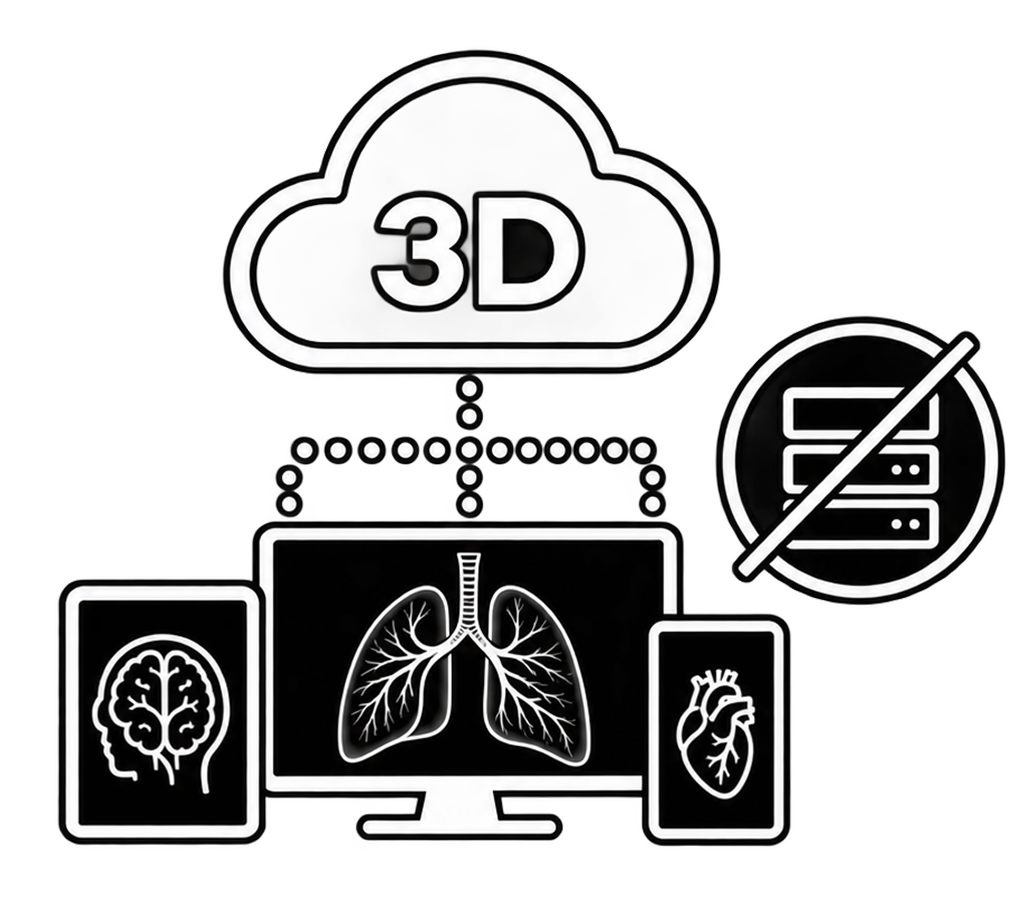
No. Tele-3D is delivered remotely, so you gain access to world-class visualization techniques without procuring new workstations, licensing post-processing software, or training in-house staff.
Is the Tele-3D protocol standardized?
Yes. We follow a standardized Tele-3D protocol developed by Massachusetts General Hospital (MGH), applied consistently across every study to reduce variability in interpretation.
How does Tele-3D integrate with our existing PACS/RIS?
Tele-3D integrates with existing imaging workflows through a secure gateway connecting to your PACS/RIS, so 2D and 3D images route seamlessly for interpretation and the final report returns directly to your RIS.
Which geography do you serve?
We serve clients across APAC, MEA, and the Americas, with infrastructure for secure cross-border image transmission and report delivery.
How do we get started?
Complete the callback form to request a service discussion. Our team will be in touch to review your case volumes and imaging workflow.
dAIgnostiX
Council Khata 180/63, Kundalahalli-ITPL Main Road,
Vishweshwaraiah Industrial Area, Whitefield
Bengaluru-560048, Karnataka, India
Vishweshwaraiah Industrial Area, Whitefield
Bengaluru-560048, Karnataka, India
Business Hours
Monday to Friday, 9:00 AM – 5:00 PM IST
Ready to Discuss Your Reporting Needs?
Share your requirements, case volumes, and geography. Our team will connect with you to discuss how dAIgnostiX can support you.